Why is PostgreSQL Popular with Modern Application Development?
Category:: Modern Technology


Modern applications need databases that can manage growing amounts of information while supporting reliable performance, security, and flexibility. As applications become more connected and data-driven, businesses are paying greater attention to the database technology behind them.
PostgreSQL has emerged as a popular option for development teams building web applications, business platforms, financial systems, analytics solutions, and other data-intensive products.
Its combination of reliability, flexibility, strong data management capabilities, and support for modern development requirements makes it relevant across many project types. Developers can also use it with popular programming languages, cloud platforms, containers, and application frameworks.
But what is PostgreSQL, and why are so many development teams considering it for new applications? Let’s find out.
What is PostgreSQL?
PostgreSQL is an open-source relational database management system designed to store, organize, and retrieve application data. It has been developed for decades and is known for supporting complex data structures and reliable database operations.
Unlike a simple data storage system, PostgreSQL provides developers with tools for working with relationships between different types of information.
For example, an e-commerce application may need to connect customers with orders, products, payments, and shipping information. A relational database can organize these connections in a structured way.
Its open-source nature also gives businesses considerable flexibility. Companies can use, modify, and deploy the database without being tied to a proprietary database license.
Why Use PostgreSQL for Modern Applications?
Developers consider PostgreSQL for several reasons when selecting a database for a new application.
It combines established relational database principles with features that support modern software development. Developers can use structured tables, relationships, transactions, advanced queries, and multiple data formats within the same database environment.
It is also suitable for applications ranging from small business websites to large enterprise platforms.
1. Flexible Data Management
Modern applications often need to manage different types of information. PostgreSQL supports traditional structured data while also handling formats such as JSON.
This flexibility allows developers to work with structured and less structured information without necessarily maintaining separate database systems.
For businesses, this can simplify application architecture and reduce the number of technologies developers need to manage.
2. Strong SQL Support
SQL remains an important skill for database development, and PostgreSQL provides extensive support for SQL-based data management.
Developers can use SQL to create tables, retrieve information, filter records, combine related data, and perform calculations.
This makes the platform familiar to developers who already have experience with relational databases while providing additional capabilities for more complex applications.
3. Open Source Foundation
Another reason for its growing adoption is its open source foundation.
Businesses do not need to depend on a single vendor for access to the database technology itself. Development teams can deploy it on their own infrastructure or use managed cloud services.
This flexibility can help organizations that want greater control over their data and application infrastructure.
PostgreSQL Performance and Application Efficiency
Database performance directly affects how quickly an application can respond to users. Slow database operations can delay websites, dashboards, ecommerce platforms, and business applications.
You can improve PostgreSQL performance through appropriate database design, indexing, query optimization, resource allocation, and configuration.
Handling Complex Queries
Applications often need to retrieve information from several related tables. PostgreSQL provides powerful query capabilities that allow developers to work with complex relationships and large datasets.
For example, a business dashboard might need to combine customer, sales, product, and regional information to generate a report.
A well-designed database can process such requests efficiently while maintaining data consistency.
Indexing and Optimization
Indexes help databases locate information without examining every record in a table.
Developers can create indexes around frequently searched or filtered information. Query analysis tools can then help identify operations that may need optimization.
Performance therefore depends on more than the database platform. Database design, application architecture, queries, hardware, and workload all contribute to the final result.
PostgreSQL Scalability for Growing Applications
As applications gain users and collect more information, their database requirements can change significantly.
PostgreSQL scalability makes it possible to support applications as their workloads increase. Developers can improve performance through better queries, indexing, resource management, database configuration, and suitable infrastructure.
Larger applications can also use additional architectural approaches when necessary.
Supporting Growing Data Volumes
A growing application may accumulate millions of customer records, transactions, product entries, or other forms of information.
PostgreSQL can manage substantial datasets when properly designed and maintained.
Developers can organize data efficiently and use appropriate indexes and queries to improve access to frequently used information.
Supporting Different Application Sizes
The database can be used for small applications as well as larger business systems.
A startup may initially use PostgreSQL for a relatively simple web application. As the business grows, the same database technology can continue supporting more users and increasingly complex requirements.
This can reduce the need for businesses to change their database technology as their applications mature completely.
Security and Data Reliability
Data security is a critical consideration for modern application development. Applications may store customer details, transactions, business records, or other sensitive information.
PostgreSQL provides several features for controlling access to stored information. Developers can create users and permissions and determine which users or applications can access particular database resources.
It also supports transactions, which help maintain data consistency when an application performs multiple related operations.
For example, when an online payment involves updating an order and recording a transaction, a transaction can help ensure that related database changes are handled consistently.
These capabilities make the platform suitable for applications where data accuracy is particularly important.
PostgreSQL Docker and Modern Development Workflows
Containers have become common in modern software development because they provide a consistent environment for running applications and their dependencies.
Developers can run PostgreSQL Docker containers locally during application development and testing.
This approach can make it easier for teams to create similar database environments across different development machines.
For example, a developer can create a database environment for a web application without manually configuring every database component on their computer.
Containers can also help with testing environments and automated development workflows.
However, containerization is only one deployment approach. Businesses can also use managed database services or traditional server infrastructure depending on their operational requirements.
PostgreSQL for Web and Business Applications
A major reason for the database’s popularity is its suitability for different application categories.
Web applications frequently need structured information about users, products, orders, content, subscriptions, and other business entities.
PostgreSQL can manage these relationships while providing developers with tools for querying and updating information.
It can also work with popular application technologies and programming languages. This makes it possible to integrate the database into different development environments rather than limiting businesses to a specific application framework.
Financial applications, content platforms, ecommerce systems, customer management platforms, analytics products, and internal business tools can all use relational database technology effectively.
PostgreSQL vs Other Database Options
Choosing a database isn’t simply about picking the most popular technology. Development teams need to consider the application’s data structure, expected workload, security requirements, budget, developer expertise, and plans.
MySQL remains widely used and can be an effective option for many applications. MongoDB can be useful when an application needs a document-focused data model. Cloud databases can provide managed infrastructure for teams that prefer not to operate their own database systems.
PostgreSQL stands out because it combines relational database capabilities with support for modern data requirements.
This makes it particularly useful for teams that want a flexible database without abandoning the structure and reliability of relational data management.
Is PostgreSQL the Right Choice for Your Application?
Start with the application, not the database.
PostgreSQL can be a strong candidate when an application needs structured relationships, reliable transactions, complex queries, flexible data formats, and room for future growth.
It can also appeal to businesses that value open source software and want flexibility in how they deploy their database infrastructure.
However, every project has different requirements. Teams should evaluate expected traffic, data volume, application architecture, development skills, operational resources, and long-term infrastructure plans before deciding.
Conclusion
PostgreSQL has become an important database option for modern application development because it combines established relational database principles with capabilities suited to today’s software requirements.
Its support for complex queries, structured relationships, flexible data formats, transactions, security controls, and scalable infrastructure makes it useful across a wide range of applications.
The database can also fit modern development practices through cloud services, containers, and different application frameworks.
For businesses building a new application or reconsidering their existing database architecture, PostgreSQL is worth evaluating based on the application’s data requirements, expected growth, development environment, and long-term goals.
Thememakker helps businesses build and optimize PostgreSQL-powered applications with secure database architecture, efficient development, scalable infrastructure, and seamless integration. Whether you are starting a new application or upgrading an existing system, our experts can support your database needs.

Frequently Asked Questions
-
Q:: How to use PostgreSQL
A:: To use PostgreSQL, install or provision a database, create a database and user, define tables, and connect your application through a supported driver. Developers can then create, retrieve, update, and manage application data using SQL.
-
Q:: How to install PostgreSQL
A:: PostgreSQL can be installed using its official installer on supported operating systems, package managers, or container tools. After installation, developers create a database, configure access, and connect their application using suitable database credentials.
-
Q:: Why is PostgreSQL becoming popular for modern application development?
A:: PostgreSQL is gaining popularity because it combines reliable relational data management with flexible data support, strong SQL capabilities, security features, and scalability. Its open-source model also gives businesses greater control over deployment.
-
Q:: Is PostgreSQL a good database for web applications?
A:: Yes, PostgreSQL is well suited to web applications that manage structured information, relationships, transactions, and growing datasets. It works with many programming languages and application frameworks, making integration practical for different development environments.
-
Q:: What are the key features of PostgreSQL for application development?
A:: Key features include relational data management, SQL support, transactions, access controls, indexing, flexible data formats, extensions, and support for large datasets. These capabilities allow developers to build applications with different data and performance requirements.
-
Q:: Is PostgreSQL better than MySQL for modern applications?
A:: Neither database is universally better. PostgreSQL offers strong support for complex relationships, advanced queries, and flexible data requirements, while MySQL suits simpler workloads. The appropriate choice depends on the application’s specific needs.
-
Q:: Can PostgreSQL handle large amounts of data?
A:: Yes, PostgreSQL can handle substantial datasets when database design, queries, indexing, infrastructure, and maintenance are properly managed. Its capabilities make it suitable for applications that need to store and process significant amounts of information.
Recommended Posts
97.9%
Projects Delivered On-Time

5,000+
Creatives & Agencies Trust Us.

Development Service?
We can provide at affordable price.


Awwwards, Design Nominees, CSSLight, Best CSS and more





THEMEFOREST
Exclusive Author
Modern Admin Dashboard Templates for Developers & Businesses
Discover professionally designed admin dashboard templates for modern web applications. Our responsive dashboards are built with Bootstrap, React, Vue.js, Angular, Tailwind CSS, Laravel, Next.js, Node.js, ASP.NET, WordPress, WebFlow, and HTML.


Feature themes
Boost your customer interactions with Templates that spark growth.
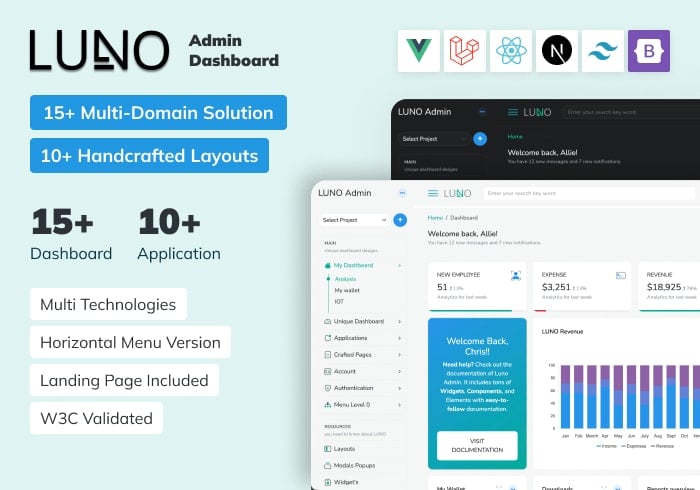
Luno – React, Vue, Laravel, Tailwind, Nextjs Admin Dashboard Template
ReacJs, Vue, Laravel, Bootstrap, Tailwind, NextJs
$19.00 0 Sales

ALUI | Bootstrap 5, ReactJS, Angular, VueJS, Laravel Admin Template
Reac, Angular, Vue, Laravel, Bootstrap
$19.00 0 Sales