Migrating Legacy Apps to Flutter: A Complete Modernization Guide
Category:: Mobile Development

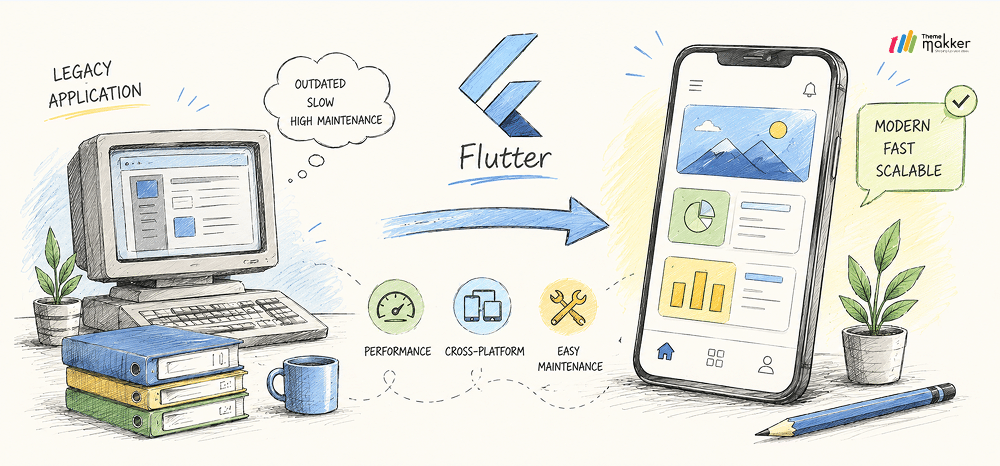
Technology evolves quickly, but many businesses still rely on applications built years ago.
While these systems may continue to function, they often struggle to keep up with changing user expectations, new operating system updates, and growing business requirements.
As a result, organizations are increasingly looking for ways to improve performance, reduce maintenance costs, and deliver better digital experiences.
One solution gaining significant attention is Flutter. Developed by Google, Flutter enables businesses to build applications for multiple platforms using a single codebase.
For companies dealing with aging software, moving to Flutter can provide a path toward modernization without starting from scratch.
This guide explores why organizations are transitioning older applications to Flutter, the challenges involved, and the best practices for a successful migration.
What Is a Legacy App?
A legacy app is software that continues to serve business operations but is built on outdated technologies, frameworks, or architectures.
These applications often perform critical functions, making them difficult to replace immediately.
While such systems may still meet basic requirements, they can create challenges over time, including:
- Slow performance
- High maintenance costs
- Limited scalability
- Security concerns
- Compatibility issues with modern devices
- Difficulty finding developers with relevant expertise
Many businesses reach a point where maintaining older software becomes more expensive than investing in modernization.
Why Businesses Are Moving to Flutter
Flutter has become a preferred framework because it allows organizations to develop applications for Android, iOS, web, and desktop platforms using a unified codebase.
This approach offers several advantages:
-
Faster Development
Developers can build and maintain features across multiple platforms without managing separate codebases.
-
Consistent User Experience
Applications maintain a uniform appearance and behavior regardless of the device being used.
-
Reduced Operational Costs
A single codebase means fewer resources are required for ongoing updates and maintenance.
-
Improved Performance
Flutter applications deliver smooth interactions and responsive interfaces that closely resemble native applications.
-
Future-Ready Architecture
Organizations can more easily adapt to changing business requirements and technology trends.
These benefits make Flutter an attractive option for companies looking to improve existing systems while maintaining long-term flexibility.
Signs It’s Time to Modernize Legacy Apps
Many organizations delay modernization until problems become impossible to ignore. However, identifying warning signs early can help avoid operational disruptions.
Consider upgrading if your application experiences:
-
Increasing Maintenance Costs
If developers spend more time fixing issues than building new features, the application may be nearing the end of its useful lifecycle.
-
Frequent Performance Problems
Slow loading times and system crashes negatively impact user satisfaction and productivity.
-
Poor User Experience
Modern users expect intuitive interfaces and seamless interactions. Older applications often struggle to meet these expectations.
-
Security Risks
Outdated technologies may no longer receive security updates, leaving systems vulnerable to threats.
-
Integration Challenges
Businesses increasingly rely on cloud services, APIs, and third-party tools. Older applications may have difficulty connecting with modern platforms.
When several of these issues occur simultaneously, modernization becomes a strategic necessity rather than a technical preference.
Understanding the Legacy App Migration Process
Successful legacy app migration involves much more than simply rewriting code. It requires careful planning, business alignment, and technical evaluation.
Step 1: Assess the Existing Application
Begin by evaluating the current application’s:
- Features
- Dependencies
- Performance issues
- User workflows
- Technical limitations
This assessment helps identify what should be retained, improved, or removed.
Step 2: Define Business Goals
Migration efforts should support broader business objectives.
Common goals include:
- Improving customer experience
- Reducing operational expenses
- Accelerating feature delivery
- Enhancing scalability
- Strengthening security
Clear objectives help guide decision-making throughout the project.
Step 3: Prioritize Features
Not every feature from the existing system may be necessary.
Analyze usage patterns and focus on functionality that provides genuine value to users and stakeholders.
Step 4: Design a Modern User Experience
Migration provides an opportunity to improve usability.
Instead of replicating outdated interfaces, teams should redesign workflows to align with current user expectations.
Step 5: Develop and Test
Once the architecture and designs are finalized, development begins.
Comprehensive testing should verify:
- Functionality
- Performance
- Security
- Device compatibility
- User experience consistency
Step 6: Deploy and Monitor
After launch, teams should closely monitor application performance and user feedback to identify opportunities for improvement.
Common Migration Approaches
Different organizations choose different migration strategies depending on their budget, timeline, and technical complexity.
1. Complete Rebuild
This approach involves rebuilding the application entirely in Flutter.
Benefits include:
- Cleaner architecture
- Better scalability
- Improved performance
However, it typically requires greater time and investment.
2. Gradual Migration
Organizations can replace sections of an application incrementally while maintaining existing functionality.
This method reduces operational risk and allows continuous business operations.
3. Hybrid Approach
Some businesses combine existing components with newly developed Flutter modules.
This strategy provides flexibility while minimizing disruption.
Selecting the right approach depends on business priorities and available resources.
Challenges Businesses May Face
Migration projects are valuable but not always straightforward.
-
Complex Business Logic
Older systems often contain years of accumulated business rules and workflows that must be carefully preserved.
-
Data Migration
Moving data between systems requires careful planning to avoid inconsistencies or information loss.
-
User Adoption
Employees and customers may need time to adjust to updated interfaces and workflows.
-
Resource Constraints
Migration projects require dedicated expertise, which can impact budgets and timelines.
-
Integration Dependencies
Many older applications connect to external systems that must continue to function after migration.
Recognizing these challenges early helps organizations develop realistic implementation plans.
Best Practices for a Successful Migration
The most successful projects follow a structured and business-focused approach.
-
Start with Clear Objectives
Define measurable outcomes before development begins.
-
Focus on User Needs
Prioritize improvements that directly enhance the user experience.
-
Modernize Incrementally
Large-scale transformations can be risky. Breaking projects into manageable phases often produces better results.
-
Invest in Testing
Extensive testing reduces deployment risks and improves reliability.
-
Maintain Documentation
Proper documentation simplifies future maintenance and onboarding efforts.
-
Partner with Experienced Teams
Experienced Flutter developers can identify risks early and implement proven migration strategies.
The Long-Term Value of Flutter Migration
Organizations often view migration as a technical initiative, but its impact extends beyond technology.
A successful transition can lead to:
- Faster product innovation
- Lower maintenance costs
- Better customer experiences
- Improved employee productivity
- Greater scalability
- Enhanced business agility
Rather than continuously patching outdated systems, businesses build a foundation that supports future growth.
As digital expectations continue to evolve, companies that proactively modernize their software are often better positioned to compete and innovate.

Conclusion
Older software systems may continue to function, but they often create limitations that slow business growth and innovation.
Migrating to Flutter provides organizations with an opportunity to improve performance, simplify maintenance, and deliver consistent experiences across multiple platforms.
Whether the goal is to reduce costs, enhance usability, or prepare for future expansion, a well-planned migration strategy can help businesses unlock greater value from their digital investments.
By approaching modernization thoughtfully and focusing on user needs, organizations can transform aging applications into scalable solutions built for the future.
Take the next step toward digital modernization with Thememakker. Our Flutter development services help businesses streamline development, enhance customer experiences, and confidently launch powerful applications across platforms.
Frequently Asked Questions
-
Q:: What are the steps for migrating a legacy app?
A:: The process typically includes assessing the existing application, defining business goals, prioritizing features, redesigning the user experience, rebuilding or migrating functionality, conducting extensive testing, and monitoring performance after deployment to ensure a smooth transition.
-
Q:: Why is legacy app migration important?
A:: Migration helps organizations overcome performance limitations, security vulnerabilities, maintenance challenges, and compatibility issues. It also enables businesses to adopt modern technologies, improve user experiences, and support future growth without being constrained by outdated systems.
-
Q:: What are the benefits of legacy app migration?
A:: Benefits include improved performance, lower maintenance costs, stronger security, enhanced scalability, faster feature releases, better user experiences, and easier integration with modern tools and cloud-based services.
-
Q:: What is a legacy app?
A:: A legacy app is an older software application that remains operational but relies on outdated technologies, frameworks, or infrastructure. While it may still support essential business functions, it often struggles to meet modern performance, security, and usability expectations.
-
Q:: How to upgrade a legacy application?
A:: Start by evaluating the application’s current state and identifying business requirements. Then modernize the architecture, improve the user interface, migrate data carefully, update integrations, and thoroughly test the application before deployment to minimize disruption.
Recommended Posts
97.9%
Projects Delivered On-Time

5,000+
Creatives & Agencies Trust Us.

Development Service?
We can provide at affordable price.


Awwwards, Design Nominees, CSSLight, Best CSS and more





THEMEFOREST
Exclusive Author
Modern Admin Dashboard Templates for Developers & Businesses
Discover professionally designed admin dashboard templates for modern web applications. Our responsive dashboards are built with Bootstrap, React, Vue.js, Angular, Tailwind CSS, Laravel, Next.js, Node.js, ASP.NET, WordPress, WebFlow, and HTML.