Multi Cloud or Hybrid Cloud: What is Best for eCommerce Growth?
Category:: Ecommerce

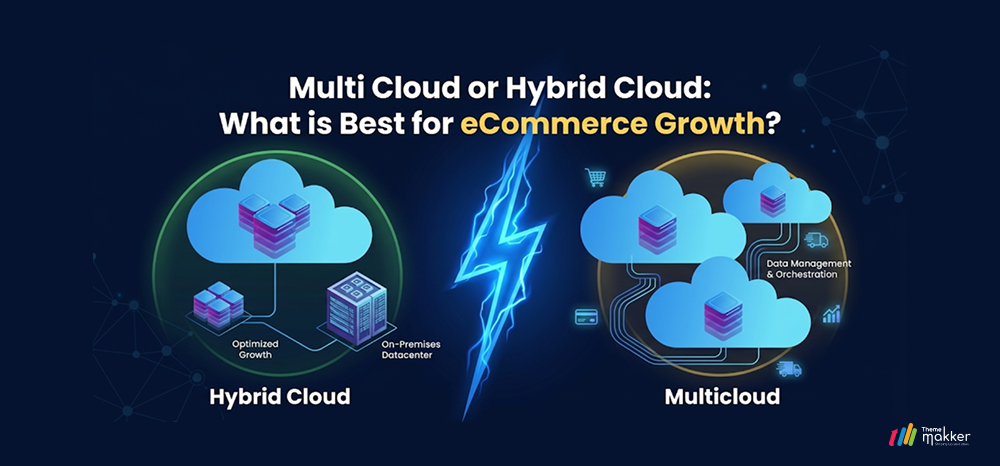
For modern eCommerce businesses, cloud infrastructure is no longer only about storing data or hosting websites. It now shapes customer experience, platform speed, payment reliability, inventory visibility, and business continuity. As online stores grow across regions and customer expectations continue to rise, choosing the right cloud approach becomes a business decision rather than only a technical one.
Many enterprises evaluating cloud infrastructure often compare multi-cloud and hybrid cloud models to determine which approach offers better performance, flexibility, and control. While both strategies support growth, they solve different business challenges.
This blog explains how these models work, the business impact they create, and which strategy may better support modern eCommerce operations.
What is Multi Cloud?
A multi-cloud approach means using cloud services from more than one provider simultaneously. Instead of depending on a single platform, companies distribute workloads across different cloud environments based on business needs.
For example, an eCommerce company may store customer analytics on one cloud platform, manage product recommendations on another, and host payment systems separately to improve performance and reliability.
The goal is flexibility. Businesses avoid relying entirely on a single provider while gaining access to the strengths of different platforms.
For growing eCommerce brands, this approach can improve service availability during sales periods, support expansion into new regions, and reduce operational risk if one provider experiences downtime.
However, managing multiple providers also requires clear planning. Teams must ensure systems communicate effectively and maintain visibility across environments.
What is Hybrid Cloud?
A hybrid cloud approach combines private infrastructure with public cloud services. Instead of placing everything in a single environment, businesses keep some operations in private systems while moving others to cloud platforms.
For example, an online retailer may store sensitive payment or customer information in private systems while using public cloud services to handle website traffic spikes during seasonal campaigns.
This model gives businesses greater control over sensitive operations while still benefiting from cloud scalability.
For e-commerce enterprises handling customer records, order histories, or regulated information, a hybrid cloud can create a balance between operational flexibility and internal control.
At the same time, maintaining both environments may increase management responsibility because businesses must oversee connections, performance, and system consistency.
Multi Cloud vs Hybrid Cloud
When comparing multi-cloud vs. hybrid cloud, the biggest difference lies in how cloud environments are structured.
Multi-cloud involves using multiple public cloud providers for different purposes. A hybrid cloud combines private infrastructure with public cloud services.
For an e-commerce company, the decision often depends on business priorities.
A retailer seeking greater flexibility and provider independence may lean toward a multi-cloud approach. Meanwhile, a business prioritizing tighter internal control over certain systems may prefer a hybrid cloud.
For example
- Multi-cloud may support faster expansion into different markets
- Hybrid cloud may help protect sensitive systems while improving scalability
- Multi-cloud can reduce reliance on a single provider
- A hybrid cloud allows businesses to maintain private environments for important operations
Neither strategy automatically wins in every case. The stronger option depends on goals, business scale, and operational requirements.
What Is the Difference Between Multi Cloud and Hybrid Cloud?
The difference comes down to infrastructure design and business priorities.
Multi-cloud uses several public cloud platforms without necessarily involving private systems. Businesses choose different providers for different tasks to improve flexibility, reduce dependency, or strengthen performance.
A hybrid cloud combines public cloud services with private infrastructure. Instead of distributing workloads across several providers, companies separate workloads between internal systems and public cloud environments.
In practical eCommerce terms:
A fashion retailer operating across many countries may adopt a multi-cloud strategy to improve performance in different regions and maintain reliability.
A healthcare product marketplace handling sensitive customer information may adopt a hybrid cloud to maintain tighter oversight of internal systems while still benefiting from cloud scalability.
The decision often comes down to whether flexibility or operational control matters more.
Hybrid Cloud vs Multi Cloud: Which Model Fits eCommerce Growth?
The comparison between hybrid cloud and multi-cloud becomes especially important for growing eCommerce businesses because digital commerce depends on speed, uptime, and customer trust.
An eCommerce platform handles many moving parts:
- Website performance
- Inventory systems
- Payment processing
- Customer support tools
- Marketing automation
- Order tracking systems
A delay in any one area can affect sales and customer experience.
Multi-cloud may work well for enterprises expanding internationally because workloads can be distributed across providers based on regional performance needs.
Hybrid cloud may work better for companies handling highly sensitive customer information or businesses that want to maintain certain systems internally.
For example, during major shopping seasons, businesses using hybrid cloud can scale public resources while maintaining important systems privately. Businesses using multi-cloud may improve reliability by balancing workloads across providers.
The right answer depends on how a company plans to scale.
Understanding Multi-Cloud vs. Hybrid Cloud for Business Decision Making
Many decision-makers ask what the difference is between multi-cloud and hybrid cloud from a business rather than a technical perspective.
The answer is simple: it is a choice between flexibility and control.
Multi-cloud often supports businesses seeking adaptability. Since services are spread across providers, companies gain greater freedom to select solutions that meet performance and cost expectations.
Hybrid cloud often supports businesses that need greater oversight of critical systems while still gaining cloud benefits where necessary.
For eCommerce leaders, this decision affects:
- Customer experience
- Business continuity
- Data visibility
- Cost planning
- Platform performance during traffic increases
Rather than asking which model sounds more advanced, businesses should ask which model best supports long-term growth.
Strategy: Multi Cloud vs Hybrid Cloud
The debate between multi-cloud and hybrid cloud strategies should focus on business outcomes rather than trends.
A multi-cloud strategy may be valuable when businesses:
- Operate across several regions
- Want provider flexibility
- Need stronger uptime support
- Want to avoid dependence on one provider
Hybrid cloud may be suitable when businesses:
- Need stronger internal control
- Handle sensitive customer information
- Want to keep important systems private
- Require gradual cloud adoption
For many eCommerce companies, the answer may not be immediate. Businesses often evolve into these models as customer expectations and operational demands grow.
A smaller retailer may begin with simpler cloud adoption before moving toward hybrid or multi-cloud structures as operations expand.
Conclusion
The truth is, there is no universal winner.
For fast-scaling online businesses seeking flexibility, broader service availability, and reduced provider dependence, multi-cloud may offer greater long-term value.
For enterprises prioritizing system control, private operations, and structured security management, a hybrid cloud may be the stronger fit.
Instead of asking which model wins universally, modern eCommerce businesses should ask which model supports their growth goals, customer expectations, and operational needs.
Cloud decisions influence performance, reliability, and business continuity. Choosing the right approach can help create smoother shopping experiences and stronger operational resilience.
Build a reliable e-commerce cloud foundation with Thememakker’s cloud services. From scalable infrastructure planning to performance-focused cloud solutions, we help businesses grow with confidence and long-term stability.

Frequently Asked Questions
-
Q:: How do multi-cloud and hybrid cloud differ in functionality?
A:: Multi-cloud focuses on using services from several cloud providers for flexibility, performance, and reliability. Hybrid cloud combines private systems with public cloud resources, helping businesses maintain greater control over important operations while still benefiting from cloud scalability and business continuity.
-
Q:: Are multi-cloud and hybrid cloud interchangeable terms?
A:: No, these terms describe different approaches. Multi-cloud involves multiple cloud providers, while hybrid cloud combines private infrastructure with public cloud environments. Although both improve flexibility, they solve different business needs and should not be treated as the same model.
-
Q:: Is multi-cloud the same as hybrid cloud?
A:: Multi-cloud is not the same as hybrid cloud because the structure behind both approaches differs. Multi-cloud spreads workloads across cloud providers, while hybrid cloud mixes internal systems with public cloud services to balance control, performance, and operational flexibility.
-
Q:: What distinguishes multi-cloud from hybrid cloud?
A:: The main distinction lies in how infrastructure is managed. Multi-cloud emphasizes provider diversity and workload distribution, while hybrid cloud combines internal systems with cloud environments to improve control, flexibility, and business continuity for sensitive operations.
-
Q:: How to choose between multi-cloud and hybrid cloud?
A:: Businesses should evaluate growth plans, customer expectations, security needs, and operational priorities. Companies seeking provider flexibility may benefit from a multi-cloud approach, while businesses requiring tighter control over systems and sensitive information may find a hybrid cloud more suitable.
Recommended Posts
97.9%
Projects Delivered On-Time

5,000+
Creatives & Agencies Trust Us.

Development Service?
We can provide at affordable price.


Awwwards, Design Nominees, CSSLight, Best CSS and more





THEMEFOREST
Exclusive Author
Modern Admin Dashboard Templates for Developers & Businesses
Discover professionally designed admin dashboard templates for modern web applications. Our responsive dashboards are built with Bootstrap, React, Vue.js, Angular, Tailwind CSS, Laravel, Next.js, Node.js, ASP.NET, WordPress, WebFlow, and HTML.