AI for Software Development: A Practical Guide for Businesses
Category:: Artificial Intelligence (AI)


Software development involves multiple stages, from understanding business requirements to designing, coding, testing, and maintaining applications. Each stage requires time, coordination, and careful decision-making.
As businesses demand faster releases and higher-quality software, traditional development approaches are evolving.
Artificial intelligence is helping development teams automate repetitive tasks, analyze large amounts of information, identify defects, and improve planning.
Rather than replacing developers, these capabilities support their work and let them focus on complex problems, creative decisions, and business requirements.
By integrating AI across the software development life cycle, organizations can reduce delays, improve productivity, and deliver reliable applications more efficiently.
Understanding where AI fits into each stage helps businesses adopt the technology strategically and achieve measurable results.
What is AI in Software Development?
AI in software development refers to using intelligent systems to assist with activities such as requirements analysis, application design, code generation, testing, documentation, and maintenance.
These systems can interpret instructions, identify patterns, generate suggestions, and analyze information that would otherwise require substantial manual effort.
For example, a developer can describe a function in natural language and ask an AI assistant to generate an initial implementation.
A testing team can use AI to identify missing test scenarios, while project managers can analyze historical delivery information to improve estimates.
The goal of AI software development is not simply to produce code faster. It improves the entire development workflow by reducing repetitive work, supporting informed decisions, and helping teams identify problems earlier.
However, AI-generated outputs still require human review. Developers must verify correctness, security, performance, and compatibility before using generated code in production applications.
How AI Accelerates the SDLC Process
The SDLC process typically includes requirements gathering, planning, design, development, testing, deployment, and maintenance.
AI can support every stage, but its impact depends on the quality of available information, the application’s complexity, and the team’s ability to validate its outputs.
1. Requirements Gathering and Planning
Understanding business needs is essential before development begins. AI tools can analyze stakeholder discussions, summarize documents, identify recurring requirements, and suggest questions that need clarification.
They can also help teams organize user stories and identify potential gaps in project specifications. This reduces documentation effort and helps developers understand the expected application behavior.
AI can support project estimation by examining previous project data and identifying patterns in delivery times. These estimates should remain starting points because unfamiliar requirements, changing priorities, and technical constraints can affect actual timelines.
2. Application Design and Architecture
Design decisions influence an application’s performance, scalability, maintainability, and security. AI assistants can compare architectural options, explain technical trade-offs, and suggest suitable technologies based on project requirements.
In AI software development, these capabilities help teams explore alternatives before committing to an implementation. AI can also help with database design, API documentation, and identifying potential integration challenges.
Architects must still evaluate the recommendations against business objectives, existing infrastructure, compliance requirements, and long-term maintenance needs.
3. Coding and Development
Coding is one of the most visible areas where AI improves productivity. Development assistants can generate code snippets, explain unfamiliar functions, suggest improvements, and help developers identify errors.
With AI for software development, teams can automate routine programming tasks, create initial implementations, and adapt existing code more efficiently. Developers can also use AI to understand unfamiliar codebases or generate documentation for functions and application components.
These benefits are especially useful for repetitive tasks, standard application features, and established programming patterns. Complex business logic still requires careful reasoning, technical expertise, and extensive validation.
4. Software Testing and Quality Assurance
Testing can consume a significant portion of development time, particularly when applications have many features and integrations. AI can generate test cases, identify edge cases, analyze results, and flag areas that need additional coverage.
It can also examine recurring defects and suggest where to focus testing efforts. This helps quality assurance teams focus on high-risk functionality instead of spending excessive time preparing routine tests.
AI does not guarantee defect-free software. Generated tests can miss important scenarios or reproduce incorrect assumptions. Human testers must verify that test cases reflect actual user needs and business rules.
5. Deployment and Release Management
Preparing software for release involves checking configurations, reviewing deployment requirements, and coordinating releases across teams. AI can assist by summarizing release changes, identifying unusual deployment patterns, and analyzing historical incidents.
It can also help teams investigate deployment failures by reviewing logs and suggesting possible causes. When combined with established automation, these capabilities can reduce investigation time and improve release preparation.
Teams should retain approval procedures for important production changes. Automated recommendations must not replace necessary security checks, recovery plans, or human oversight.
6. Maintenance and Continuous Improvement
Software requires ongoing updates to fix defects, improve performance, and meet changing user needs. AI can analyze application logs, group similar error reports, explain unfamiliar code, and suggest possible fixes.
It can also help teams identify recurring support requests and areas where users struggle. These insights can inform future development priorities and improve application reliability.
Throughout the SDLC, AI becomes more valuable when teams use feedback from testing, production monitoring, and user interactions to guide improvements.
Key Benefits of AI Software Development
Adopting AI can boost productivity across development teams, but results depend on how well the technology fits existing workflows.
1. Faster Delivery
AI reduces time spent on routine coding, documentation, test preparation, and information gathering. Developers can use the saved time to solve complex problems and complete important features sooner.
2. Improved Software Quality
AI-assisted analysis can identify potential defects, missing test cases, and suspicious code patterns earlier. This gives teams more opportunities to address problems before they affect users.
3. Lower Development Costs
Automation can reduce repetitive manual work and shorten certain development activities. However, savings depend on licensing costs, integration effort, training requirements, and the additional review needed to validate AI-generated outputs.
4. Better Developer Productivity
AI assistants help developers explore unfamiliar technologies, understand existing code, and resolve common programming issues. These capabilities can improve team efficiency without removing the need for technical knowledge.
5. More Informed Decisions
AI can summarize project information, analyze recurring defects, and reveal patterns in application performance. Teams can use these insights to prioritize improvements and allocate resources more effectively.
Challenges of Using AI in Software Development
AI adoption introduces risks that organizations must address before relying on generated outputs. AI systems can produce incorrect code, misunderstand requirements, recommend outdated approaches, or overlook security weaknesses.
Sensitive source code and customer information also require careful handling. Organizations should establish clear rules about which tools developers may use and what information they can submit.
Another challenge is excessive dependence on automation. Developers who accept suggestions without understanding them may introduce defects or create hard-to-maintain code.
To manage these risks, businesses should establish review procedures, protect confidential information, evaluate tool performance, and train employees to use AI responsibly. Clear accountability remains essential for every important development decision.
How to Implement AI Across the SDLC
A successful implementation starts with specific business objectives, not simply adopting AI because the technology is available.
1. Start with Repetitive Tasks
Identify activities that consume substantial time, such as writing documentation, generating routine code, preparing tests, or summarizing error logs. Introduce AI tools where they can address these tasks with limited disruption.
2. Choose Suitable Tools
Evaluate tools according to programming language support, integration capabilities, security controls, cost, and ease of use. Run a pilot project before introducing them across the organization.
3. Establish Human Review
Define which outputs require developer approval, security assessment, or additional testing. Ensure employees understand that generated suggestions must be checked before entering production systems.
4. Measure Results and Expand Gradually
Track delivery time, defect rates, review effort, and developer feedback before and after adoption. Use these measurements to determine whether the tools deliver meaningful improvements, then expand successful practices to additional stages.
Conclusion
AI is changing how organizations plan, build, test, deploy, and maintain applications. When applied thoughtfully, it can reduce repetitive work, improve development visibility, and help teams deliver software more efficiently.
The strongest results come from integrating AI into existing processes while maintaining human judgment, security controls, and quality standards. Businesses that identify suitable use cases, measure outcomes, and continuously improve their approach can make AI a practical part of modern software engineering.
Thememakker helps businesses leverage AI to streamline software development, automate repetitive tasks, and improve application quality. Build smarter, more efficient software solutions with tailored AI strategies that accelerate delivery and support business growth.

Frequently Asked Questions
-
Q:: How to use AI in software development?
A:: Use AI tools to assist with requirements analysis, code generation, documentation, testing, and debugging. Start with repetitive tasks, review all important outputs, and integrate successful tools into existing workflows to boost productivity without compromising software quality.
-
Q:: How is AI transforming software development?
A:: AI is transforming software development by automating routine tasks, helping developers find defects, suggesting code, and improving project planning. These capabilities allow teams to spend more time solving complex problems and delivering features that meet user expectations.
-
Q:: How to implement AI in software projects?
A:: Begin by identifying project activities that consume considerable time or resources. Select suitable AI tools, establish data protection rules, train developers, and test them on a small project. Measure productivity, quality, and costs before expanding adoption.
-
Q:: What does AI mean in software development?
A:: AI in software development means using intelligent systems to support activities such as coding, testing, planning, and maintenance. These systems analyze information, recognize patterns, and suggest solutions, helping developers work efficiently while keeping responsibility for key decisions.
-
Q:: How does AI speed up the software development process?
A:: AI speeds up development by generating routine code, preparing test cases, summarizing requirements, and helping developers investigate errors. Automating these activities reduces manual effort, letting teams complete tasks faster while maintaining proper testing and review processes.
-
Q:: Can AI reduce software development time and costs?
A:: Yes, AI can reduce development time and costs by automating repetitive work and improving defect detection. However, actual savings depend on implementation expenses, project complexity, tool quality, employee training, and the effort required to verify generated results.
-
Q:: What are the benefits of using AI throughout the SDLC?
A:: Using AI throughout the SDLC can improve productivity, accelerate delivery, strengthen testing, support maintenance, and provide better project insights. Connecting these capabilities across development stages helps teams identify problems earlier and make more informed decisions about software quality and priorities.
Recommended Posts
97.9%
Projects Delivered On-Time

5,000+
Creatives & Agencies Trust Us.

Development Service?
We can provide at affordable price.


Awwwards, Design Nominees, CSSLight, Best CSS and more





THEMEFOREST
Exclusive Author
Modern Admin Dashboard Templates for Developers & Businesses
Discover professionally designed admin dashboard templates for modern web applications. Our responsive dashboards are built with Bootstrap, React, Vue.js, Angular, Tailwind CSS, Laravel, Next.js, Node.js, ASP.NET, WordPress, WebFlow, and HTML.


Feature themes
Boost your customer interactions with Templates that spark growth.
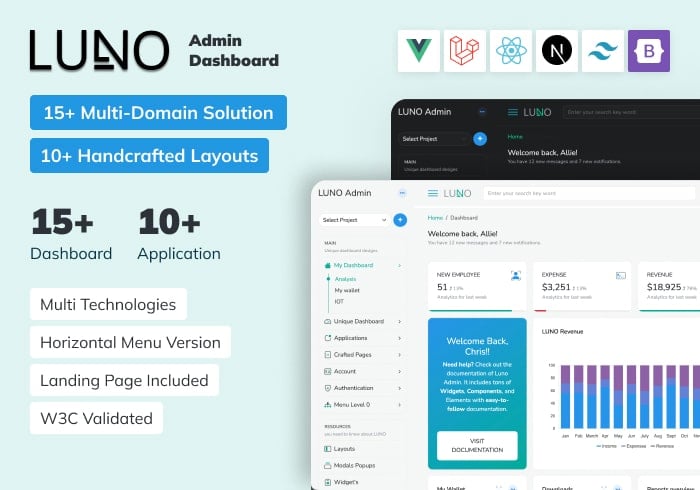
Luno – React, Vue, Laravel, Tailwind, Nextjs Admin Dashboard Template
ReactJs, Vue.js, Laravel, Bootstrap, Tailwind, NextJs
$19.00

ALUI | Bootstrap 5, ReactJS, Angular, VueJS, Laravel Admin Template
ReactJS, Angular, Vue.js, Laravel, Bootstrap
$19.00