What Is AI-Native Cloud A Complete Guide for Enterprises in 2026
Category:: Artificial Intelligence (AI)

In recent years, cloud adoption has stayed at the forefront of digital transformation. According to Spacelift.io , the cloud computing market is expected to reach $947.3 billion by the end of 2026.
However, as we enter 2026, it has become clear that being ‘cloud-first’ alone isn’t sufficient. With the evident rise of other emerging technologies, such as Artificial Intelligence, enterprises today are shifting towards AI-native cloud architectures.
This marks a shift in which intelligence is at the core of all layers of cloud infrastructure, operations, and development. Additionally, the introduction of AI cloud platforms fosters data-driven decision-making with real-time contextual knowledge.
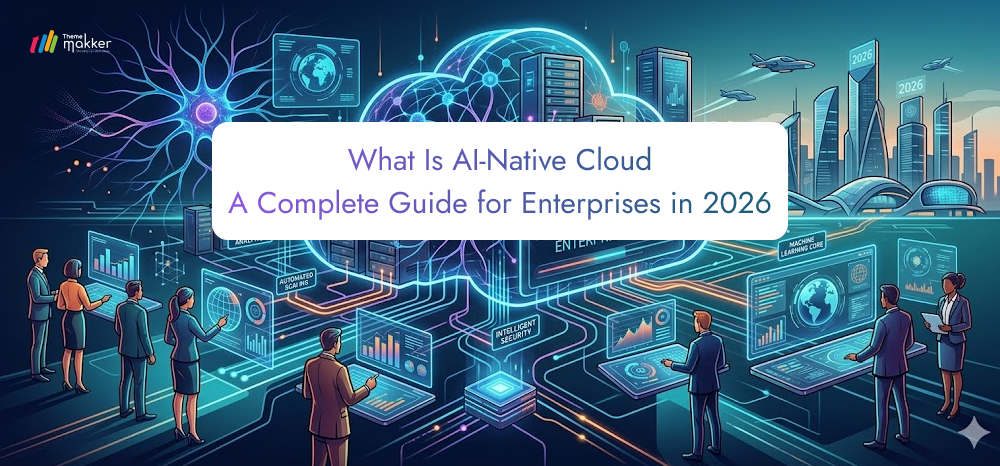
This article covers the basics of AI-Native Cloud, why it’s crucial for modern enterprises, its benefits, the top 3 use cases across industries, challenges, and the adoption framework.
What is AI-Native Cloud?
AI-Native Cloud refers to cloud systems optimized to run artificial intelligence workloads efficiently at scale. Unlike traditional clouds that simply add AI tools, these systems have AI built into their foundation.
They connect hardware, software, and services to support learning models end-to-end. Here are some of the core characteristics of AI-native cloud.
AI-First Design
Systems are built with model training and prediction as the primary goals, not as an afterthought.
Smart Hardware
Powerful chips like GPUs and TPUs are deeply integrated to speed up processing.
Built-in Automation
Tasks such as scaling, cost control, and security are managed by intelligent systems.
Easy ML Workflows
It supports smooth data flow, model building, deployment, and monitoring with built-in tools.
Why AI-Native Cloud Matters for Modern Enterprises?
Why should IT leaders care about AI-native cloud? Because this shift is not only about technology, it directly impacts how businesses compete, operate, and grow. It helps organizations become faster, smarter, and more adaptable in a rapidly changing market.
Strategic Value
Many companies have already moved to the cloud through basic migration and optimization. The next step is adding intelligence across systems. AI is no longer separate; it is becoming a core part of how cloud platforms are built and used, making it essential for future growth.
Business Impact
When intelligence is built into infrastructure, businesses can make quicker decisions and automate routine work. It also enables predictive insights, helping companies anticipate trends and create new services or revenue streams. Organizations using AI effectively often innovate faster and achieve better results.
IT Evolution
Traditional cloud strategies focus on scaling and efficiency. AI-native approaches go further by emphasizing data, continuous learning, and real-time decision-making. Infrastructure is no longer just about storage or computing; it becomes a system that actively learns and improves over time.
Competitive Edge
Companies adopting AI-native cloud can shift from reacting to problems to preventing them. Systems can self-optimize, predict failures, and automatically improve performance. This level of intelligence helps businesses stand out, especially in industries where speed and accuracy matter most.
5 Key Benefits of AI Cloud Platforms
AI is reshaping cloud computing by making systems smarter, faster, and more efficient. It helps businesses automate routine tasks, gain deeper insights from data, and reduce costs. By combining intelligence with scalability, AI enables organizations to operate faster, more accurately, and with greater flexibility in dynamic environments.
Smart Automation
AI-powered cloud platforms can automatically monitor systems, detect issues, and fix them with minimal human input. This reduces manual workload, lowers the risk of errors, and improves system uptime. Faster provisioning and maintenance also help teams operate more efficiently.
Advanced Analytics
AI can process massive amounts of data quickly, turning it into meaningful insights. These insights support better decision-making for both business and IT teams. With predictive and prescriptive analytics, organizations can identify trends early and act with confidence.
Cost Optimization
AI helps optimize cloud spending by allocating resources based on real-time demand. It ensures workloads run on the most efficient infrastructure, avoiding overuse or waste. This leads to better resource utilization and significant cost savings over time.
Real-Time Scaling
AI enables dynamic allocation of compute, storage, and network resources. By analyzing usage patterns, it can predict demand spikes and adjust capacity instantly. This reduces downtime, improves performance, and ensures smooth user experiences even during traffic surges.
Operational Agility
AI reduces the burden on IT teams by automating repetitive tasks and streamlining workflows. This allows teams to focus on innovation and strategic work. It also helps businesses adapt quickly to changes, supporting faster transformation and improved service delivery.
Top 3 Real-World Use Cases of AI-Native Cloud Infrastructure
Healthcare
AI cloud platforms help hospitals analyze medical images instantly, enabling faster diagnoses. They allow continuous model updates as new patient data becomes available.
With built-in security and compliance standards, healthcare providers can ensure safe data handling while improving accuracy, treatment speed, and overall patient care outcomes.
Finance
AI-native infrastructure enables financial institutions to detect fraud in real time by analyzing large volumes of transactions within seconds. These systems continuously learn from new fraud patterns, improving accuracy over time.
This helps reduce financial risks, strengthen security measures, and ensure faster, more reliable transaction monitoring.
Retail
Retail businesses use AI-native cloud systems to deliver personalized customer experiences, predict demand, and adjust pricing instantly. These platforms improve inventory management and reduce stock issues.
By processing data in real time, retailers can respond quickly to market changes, thereby enhancing customer satisfaction and sales performance.
How to Transition to an AI-Native Cloud?
Shifting to an AI-native cloud requires a structured approach that aligns technology with business goals. It is not just about adopting new tools, but about redesigning systems to support intelligent, data-driven operations.
Organizations need to evaluate their current environment, choose the right platforms, and build a strong foundation for scalable AI workloads.
Workload Analysis
The first step is to understand your existing workloads and identify where AI can create the most value. Focus on applications that handle large volumes of data or require real-time decision-making.
These workloads often benefit the most from AI and can deliver faster returns when optimized. This evaluation also helps prioritize migration efforts and ensures resources are allocated effectively.
Platform Selection
Choosing the right cloud provider is critical for a successful transition. Look for platforms that offer built-in AI capabilities such as hardware accelerators, pre-configured machine learning pipelines, and intelligent monitoring tools.
These features reduce the complexity of deploying AI solutions and improve performance. A strong platform also ensures better scalability, security, and long-term flexibility.
Container Strategy
Modern AI-native environments rely heavily on containerization to manage and scale workloads efficiently. Technologies like Kubernetes act as the backbone for orchestrating applications, ensuring they run smoothly across different environments.
By adopting containers, organizations can improve portability, simplify deployment, and maintain consistency across development and production systems. This approach also supports faster experimentation and iteration.
Data Unification
AI systems depend on high-quality, accessible data. Building a unified data platform is essential to bring together data from multiple sources, including data lakes, warehouses, and real-time streams.
This unified approach enables seamless data flow, supports advanced analytics, and improves model accuracy. It also ensures teams can access and use data efficiently, without silos slowing progress.
Overall, transitioning to an AI-native cloud is a gradual but strategic process. With the right planning and tools, businesses can unlock the full potential of AI and build more intelligent, scalable systems.
Conclusion
AI-native cloud is redefining how enterprises approach digital transformation by embedding intelligence into every layer of infrastructure. Unlike traditional cloud models, it goes beyond scalability and efficiency to enable real-time decision-making, continuous learning, and proactive operations.
From enhanced automation and advanced analytics to cost optimization and operational agility, the benefits are both immediate and long-term.
As seen across industries like healthcare, finance, and retail, AI-native cloud unlocks new levels of performance, innovation, and customer experience. However, achieving this requires a clear strategy, workload evaluation, platform selection, container adoption, and the creation of a unified data ecosystem.
Ultimately, organizations that embrace AI-native cloud are better positioned to innovate faster, respond to change effectively, and maintain a competitive edge. As the cloud landscape evolves, integrating AI at its core is no longer optional; it is essential for future-ready, intelligent enterprises.
If you’re looking to make this shift, connect with ThemeMakker to build AI-native cloud strategies, optimize infrastructure, and accelerate digital transformation with expert-driven solutions tailored to your business needs.
Frequently Asked Questions
- Q:: What are the best AI cloud platforms available?
A:: Leading AI cloud platforms include offerings from major providers like AWS, Microsoft Azure, and Google Cloud. These platforms provide tools for model training, deployment, and scaling. They also offer integrated AI services, strong infrastructure, and support for advanced analytics, making them suitable for enterprise-grade AI workloads.
- Q:: What are the pricing models of AI cloud platforms?
A:: AI cloud platforms typically follow pay-as-you-go, subscription-based, or reserved pricing models. Costs depend on compute usage, storage, and AI services like model training or inference. Some providers also offer tiered pricing and discounts for long-term commitments, helping businesses manage budgets while scaling AI workloads efficiently.
- Q:: What security features do AI cloud platforms offer?
A:: AI cloud platforms include robust security features such as data encryption, identity and access management, threat detection, and compliance support. They also offer monitoring tools and automated security updates. These features ensure that sensitive data and AI models remain protected across cloud environments and meet regulatory requirements.
- Q:: How does AI-native infrastructure work?
A:: AI-native infrastructure integrates AI across all layers of the cloud stack. It uses specialized hardware, automated resource management, and continuous learning models to optimize performance. This setup enables efficient data processing, real-time decision-making, and seamless deployment of machine learning workflows at scale.
- Q:: How is AI-native infrastructure used in enterprises?
A:: Enterprises use AI-native infrastructure to automate operations, improve decision-making, and scale AI applications. It supports use cases like predictive analytics, fraud detection, and personalized services. By combining data, computing power, and AI models, businesses can innovate faster and adapt quickly to changing market demands.
Recommended Posts
97.9%
Projects Delivered On-Time

5,000+
Creatives & Agencies Trust Us.

Development Service?
We can provide at affordable price.


Awwwards, Design Nominees, CSSLight, Best CSS and more


THEMEFOREST
Exclusive Author
Boost Backend Efficiency with Cutting-Edge Web Technologies
Accelerate your backend development with our premium admin dashboard templates powered by today’s top frameworks and libraries—Bootstrap, Tailwind CSS, React, Vue.js, Angular, Laravel, Node.js, WordPress, Next.js, ASP.NET, and more. Whether you're building a SaaS platform, CRM, or internal tool, our dashboards offer clean design, modular code, and full responsiveness to help you build faster and smarter.





